
id
If you use your tax-free lump sum from a pension to make a new or increased payment to a pension plan, this could be what the government call ‘recycling’ and be subject to a tax charge. This includes payments made by you, your employer or any third party.
The key things the government will consider are whether the increase was:
Pre-planned
What matters is your intention at the relevant time. The government need to prove that you had planned to use your tax-free lump sum to get more tax relief by making the new or increased payment.
To do this, they will look at the evidence available to them. This can include looking at any increased payments to your pension plan made in the two tax years before and after you received your tax-free lump sum.
Here’s two basic examples:
| Situation | Proving it was pre-planned | Relevant time | |
|---|---|---|---|
| Example 1 |
You took out a loan for £20,000 and paid this into your pension. A year later, you took a tax-free lump sum of £19,000 from your pension. You then paid the loan off. |
A comment you made on your loan application, saying you would use your tax-free lump sum to pay off the loan. | Date the payment was made to your pension plan. |
| Example 2 |
You took a tax-free lump sum of £50,000 from your pension. A few months later, you paid a single payment of £20,000 into your pension. |
A letter you sent to an adviser saying you wanted to reinvest your tax-free lump sum in your pension. |
Date the tax-free lump sum was paid. |
id
‘Significant’
A significant increase is:
- Over 30% of the tax-free lump sum you’ve taken, and
- Under the government’s rules, normally more than 30% of the payments being made to your pension.
To work out the total increase in payments, the government can look at the two tax years before you took your tax-free lump sum, plus the year you received it and the two tax years after.
Made before or after you took a tax-free lump sum of more than £7,500
(This includes any other tax-free lump sum taken in the last 12 months.)
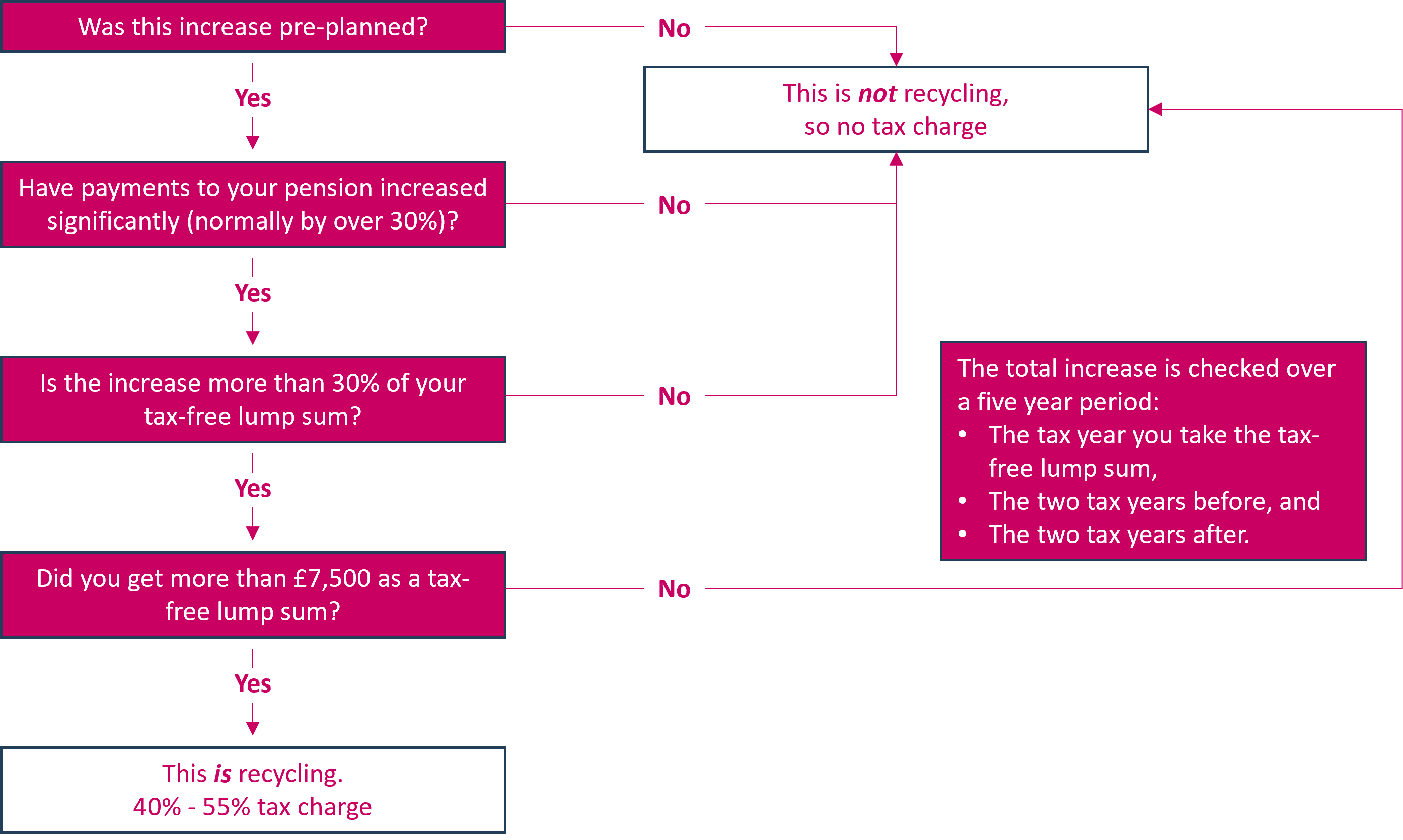
So, to be recycling, the increase has to be pre-planned, significant and you need to have taken a tax-free lump sum greater than £7,500.
What if my payment is recycling?
You’ll have to pay a tax charge of between 40%-55% of the tax-free lump sum taken.
You must contact your provider urgently that paid out your tax-free lump sum. They could also face a tax charge, normally of 15%, of the tax-free lump sum paid out to you.
Decision tree — is it recycling?
id
From 6 April 2024 onwards, there are no longer any limits on the total amount you can save into a pension. However, there are limits on the amount of tax-free lump sums.
This limit is £268,275 across all pension schemes, unless it relates to a death or serious ill-health claim in which case the limit rises to £1,073,100.
If you’ve previously applied for lifetime allowance protection, you may have a higher tax-free allowance.
For more information, speak to a financial adviser or please contact us if you need further help.
Laws and tax rules may change in the future. The information here is based on our understanding in March 2026. Your personal circumstances and where you live will also have an impact on tax treatment.